

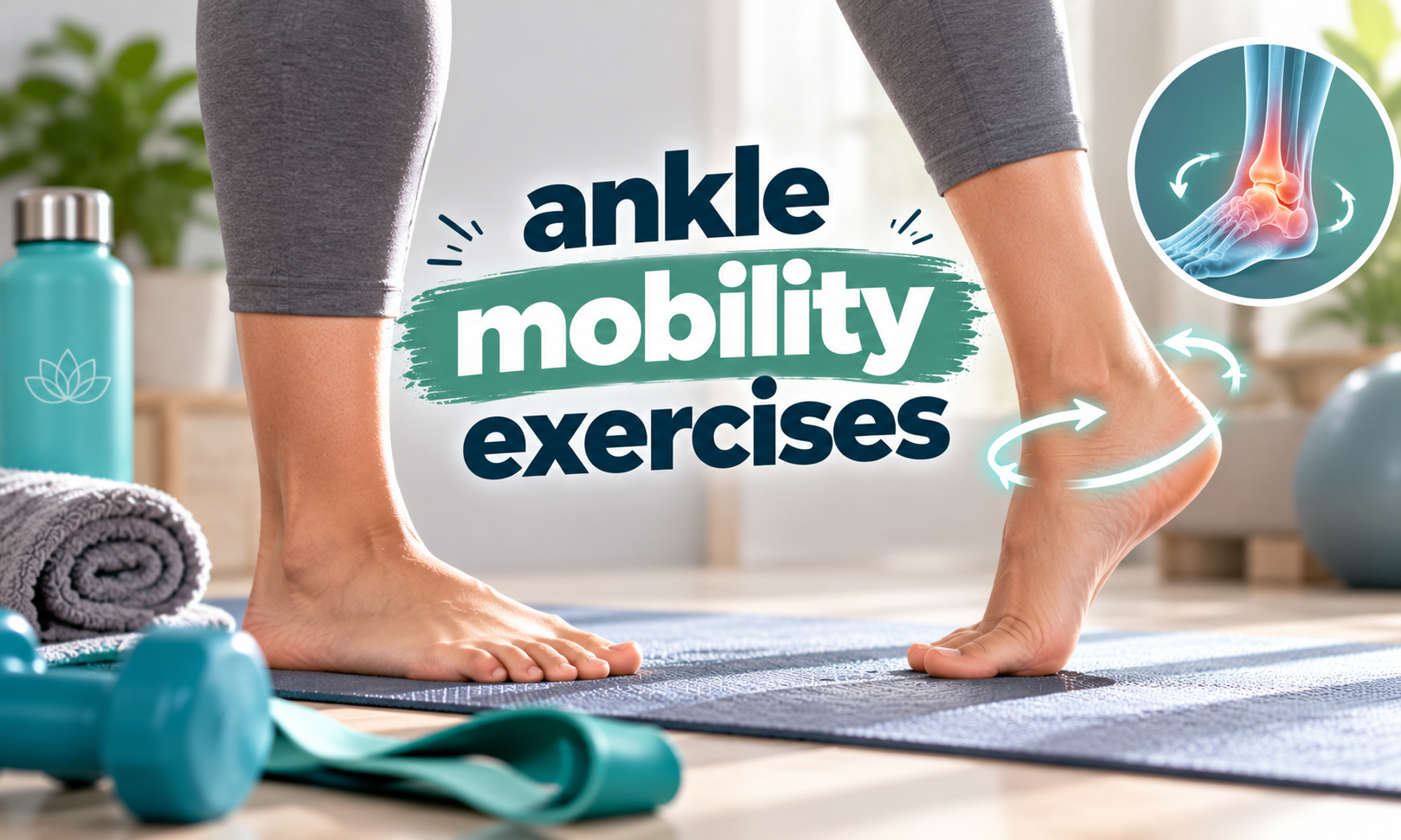
A practical routine for ankle circles, calf stretching, knee-to-wall mobility, heel raises, band work, and balance
The best ankle mobility exercises improve both range of motion and control. A mobile ankle should be able to move the knee forward over the foot, point the toes, rotate comfortably, and stay stable during walking, squatting, running, and balance tasks.
Limited dorsiflexion is common after sprains, immobilization, calf tightness, or years of stiff footwear. A useful routine combines mobility drills with calf stretching, strengthening, and balance work rather than relying on stretching alone.
What Does Ankle Mobility Mean?
Ankle mobility describes how freely the joint and surrounding muscles and tendons move through useful ranges. The two main motions are dorsiflexion, which brings the top of the foot toward the shin, and plantar flexion, which points the foot downward.
Side-to-side movement and rotation also matter because the ankle and foot constantly adapt to uneven ground and changes in body position.
Healthline’s ankle mobility guide recommends combining range-of-motion, strengthening, and balance exercises.
Why Is Dorsiflexion So Important?
Dorsiflexion lets the shin move forward over the foot while the heel stays down. You use it when descending stairs, squatting, lunging, walking uphill, and landing from a step or jump.
When dorsiflexion is limited, the body may compensate by lifting the heel, turning the foot outward, collapsing the arch, or moving more through the knee and hip.
8 Effective Ankle Mobility Exercises
| Exercise | Main Focus | Suggested Dose | Best Use |
| Ankle circles | General range of motion | 10 each direction | Warmup and daily mobility |
| Alphabet drill | Multi-direction ankle motion | 1 alphabet each foot | Gentle mobility |
| Knee-to-wall drill | Weight-bearing dorsiflexion | 2 x 8-12 each side | Squat and lunge mobility |
| Straight-knee calf stretch | Gastrocnemius flexibility | 20-30 sec x 2-3 | Calf tightness |
| Bent-knee calf stretch | Soleus flexibility | 20-30 sec x 2-3 | Deep dorsiflexion restriction |
| Banded dorsiflexion | Anterior tibialis strength | 3 x 10 | Active dorsiflexion control |
| Heel raises | Calf strength and plantar flexion | 2-3 x 10-15 | Walking and push-off strength |
| Single-leg balance | Stability and proprioception | 3 x 20-30 sec | Ankle control and sprain recovery |
1. Ankle Circles
Sit or lie down with the leg supported. Slowly draw a circle with the foot, moving only through the ankle rather than rotating the whole leg. Perform about 10 circles in each direction within a pain-free range.
2. Alphabet Drill
Lift one foot slightly and use the big toe as if it were a pencil. Trace the alphabet in the air. This moves the ankle through several directions without equipment and works well after sitting or as a warmup.
3. Knee-to-Wall Dorsiflexion Drill
Stand facing a wall with one foot flat. Keep the heel down and slowly drive the knee toward the wall over the second or third toe. Move the foot slightly farther away as the motion becomes easier.
Stop if you feel a sharp pinch in the front of the ankle. A gentle calf or ankle stretch is expected, but pain is not.
4. Straight-Knee Calf Stretch
Place both hands on a wall and step one foot behind you. Keep the back knee straight and the heel down while leaning forward. This emphasizes the gastrocnemius. Hold without bouncing.
5. Bent-Knee Calf Stretch
Use a similar stance, but bend the back knee slightly while keeping the heel down. You should feel the stretch lower in the calf near the Achilles tendon. This targets the soleus.
6. Banded Ankle Dorsiflexion
Sit with the leg straight and anchor a resistance band in front of you. Loop it around the forefoot and pull the toes toward the shin against the band.
The AAOS 2025 foot and ankle conditioning program recommends 3 sets of 10 for banded dorsiflexion and plantar flexion. Keep the heel supported and move slowly.
7. Heel Raises
Stand behind a chair or counter and rise onto the balls of both feet, then lower slowly. Start with two legs and progress to single-leg heel raises when you can control the movement.
8. Single-Leg Balance
Stand near a stable support and balance on one leg for 20 to 30 seconds. Use your fingertips as needed. AAOS includes single-leg balance because it challenges the muscles of the foot and ankle while improving proprioception.
To progress, reduce hand support or stand on a folded towel. Only use more difficult variations in a safe environment.
How Often Should You Work on Ankle Mobility?
Gentle range-of-motion drills can usually be done daily if they do not increase pain or swelling. Calf stretching can also be performed regularly, especially if stiffness returns after sitting or training.
Strength work such as heel raises and resistance-band exercises usually fits well two or three times per week, while low-load balance drills can be done more frequently.
How Can You Tell if Mobility Is Improving?
One simple option is the knee-to-wall test. Keep the heel down and move the knee forward until it touches the wall without the arch collapsing. Record how far the toes are from the wall and repeat the same setup every few weeks.
You may also notice easier squatting, smoother stair descent, less heel lifting, or improved balance.
What Common Mistakes Should You Avoid?
Do not force the knee forward while the heel lifts, because that creates the appearance of greater dorsiflexion without actually improving it. Avoid bouncing aggressively into calf stretches.
Another mistake is stretching an unstable ankle without strengthening it. If you have a history of recurrent sprains, balance and strengthening work are especially important.
Can Ankle Mobility Exercises Help After a Sprain?
They can be an important part of rehabilitation once the injury has reached the appropriate stage. Loss of dorsiflexion, weakness, and poor balance are common after ankle sprains.
Research reviews support exercise therapy for reducing recurrent sprain risk and suggest stretching can improve dorsiflexion after ankle injury.
A recent sprain with major swelling, inability to bear weight, severe bruising, or suspected fracture should be assessed before you push mobility work.
When Should You See a Physical Therapist or Doctor?
Get professional advice if ankle stiffness is persistent, worsening, or accompanied by significant pain, repeated giving-way episodes, swelling, numbness, or loss of function.
A clinician can determine whether the limit comes from calf tightness, joint stiffness, an old sprain, arthritis, tendon problems, scar tissue, or another cause.
Frequently Asked Questions
What is the best exercise for ankle dorsiflexion?
The knee-to-wall drill is one of the most practical because it trains dorsiflexion in a weight-bearing position while keeping the heel down.
How long does it take to improve ankle mobility?
Some people notice short-term improvement after stretching, but lasting change usually requires consistent practice over several weeks.
Should I stretch my ankles every day?
Gentle stretching and mobility can often be done daily if they do not increase pain or swelling.
Do heel raises improve ankle mobility?
Heel raises mainly improve calf strength and plantar flexion, but stronger calf muscles and better control support overall ankle function.
Why is one ankle less mobile than the other?
Previous sprains, surgery, calf tightness, joint stiffness, swelling, arthritis, or habitual movement patterns can create side-to-side differences.
Can poor ankle mobility affect squats?
Yes. Limited dorsiflexion can make the heels rise, push the feet outward, or change knee and hip mechanics during a squat.
Final Thoughts
A useful ankle mobility routine combines range-of-motion drills, calf stretching, dorsiflexion strengthening, heel raises, and balance work. Ankle circles, knee-to-wall drills, calf stretches, banded dorsiflexion, heel raises, and single-leg balance cover those needs well.
Use controlled movement rather than forcing range, track your own progress, and add strength as mobility improves. Persistent pain, swelling, instability, or major loss of motion deserves professional assessment.
This article is written for a U.S. audience using exercise and orthopedic guidance available in October 2026. People recovering from fractures, surgery, severe ankle sprains, or significant arthritis may need individualized rehabilitation.