

A practical routine for the iliopsoas, rectus femoris, glutes, core, and hip stability
The best hip flexor strengthening exercises train the muscles that lift the thigh toward the torso while also improving pelvic control. The hip flexors include the iliopsoas, rectus femoris, sartorius, and related muscles that help with walking, running, climbing stairs, kicking, and maintaining balance.
Many people assume tight hip flexors only need stretching, but a muscle can feel tight and still be weak. Long hours of sitting may reduce hip strength and control, while aggressive stretching alone may not solve the problem. A better approach combines active hip flexion, glute strength, core stability, and gradual loading.
Why Strengthen the Hip Flexors?
Strong hip flexors help lift the leg efficiently during walking, sprinting, stair climbing, and sports. They also contribute to trunk and pelvis stability when you carry, push, or pull.
Healthline notes that weak and tight hip flexors can contribute to hip discomfort and movement problems, especially in people who sit for long periods. It also emphasizes strengthening the surrounding glutes, hamstrings, abductors, and adductors so the pelvis is not relying on one muscle group.
The 2026 ACSM resistance-training guidance similarly emphasizes simple, consistent progressive resistance training rather than complicated programming.
8 Effective Hip Flexor Strengthening Exercises
| Exercise | Main Focus | Suggested Dose | Beginner Option |
| Standing knee march | Hip flexors + balance | 2-3 x 10-15 each side | Hold a wall or chair |
| Seated knee lift | Iliopsoas isolation | 2-3 x 10-15 each side | Use body weight only |
| Resisted band march | Hip flexion strength | 2-3 x 8-12 each side | Use a lighter band |
| Straight-leg raise | Hip flexors + quads | 2-3 x 8-12 | Bend the opposite knee |
| Step-up with knee drive | Hip flexors + glutes | 2-3 x 8-12 each side | Use a low step |
| Reverse lunge | Hip flexors + glutes + quads | 2-3 x 8-12 each side | Shorten the range |
| Dead bug march | Hip flexors + core | 2-3 x 6-10 each side | Keep feet closer to floor |
| Hanging knee raise | Hip flexors + trunk control | 2-3 x 6-12 | Use a captain’s chair |
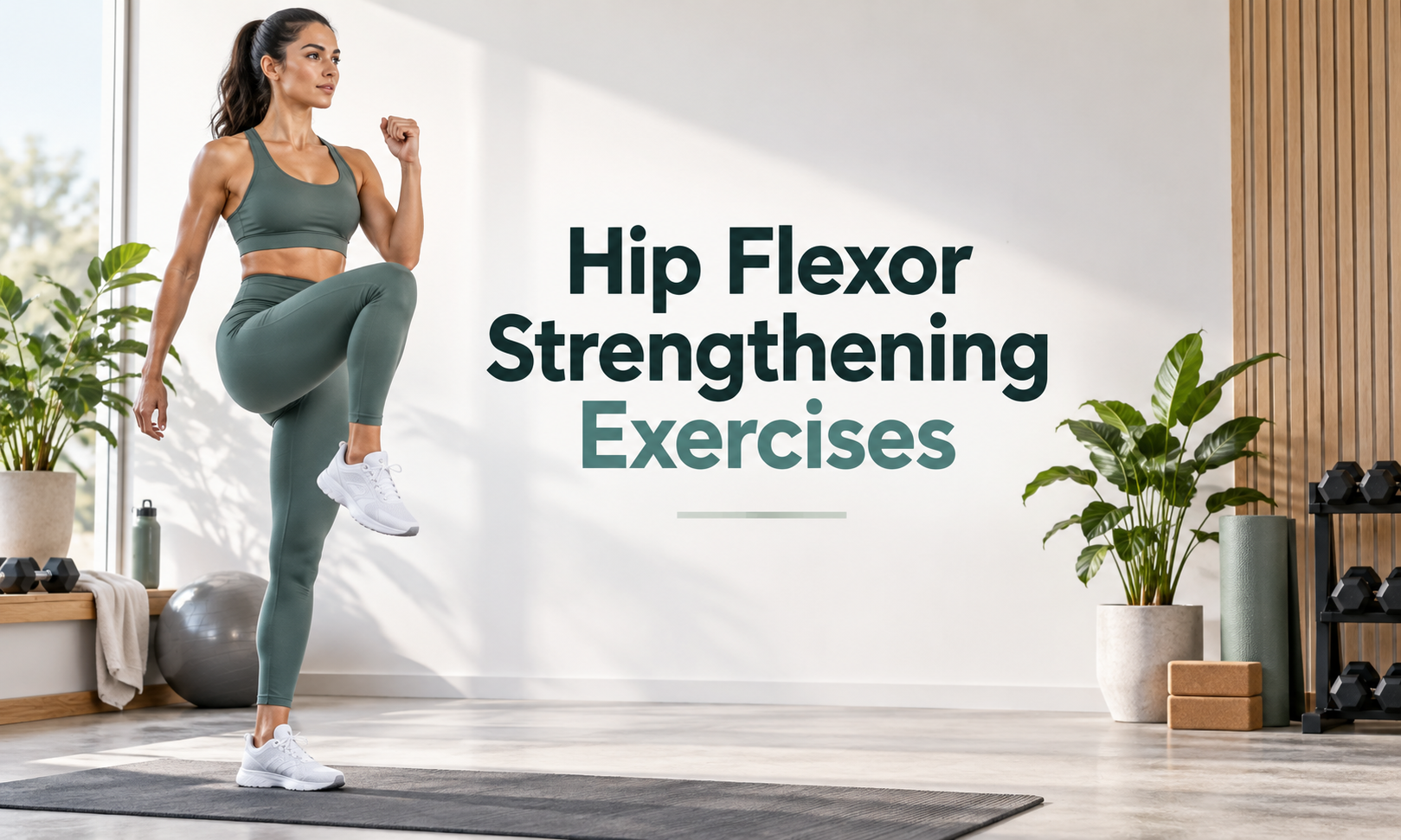
1. Standing Knee March
Stand tall and slowly lift one knee toward hip height without leaning backward. Pause briefly, lower with control, and repeat on the other side.
This is one of the simplest ways to train active hip flexion. To make it harder, add ankle weights, hold a light dumbbell at the chest, or loop a mini band around the feet.
2. Seated Knee Lift
Sit near the edge of a sturdy chair with your torso upright. Lift one knee a few inches without rounding the back or leaning away from the working side.
The seated position reduces balance demands and lets you focus on the iliopsoas. If body weight becomes easy, place a light ankle weight on the working leg.
3. Resisted Band March
Anchor a resistance band behind you and loop it around one foot or ankle. Stand tall and drive the knee forward and upward against the band’s resistance.
This creates resistance through hip flexion without requiring heavy equipment. Keep the pelvis level and avoid arching the lower back.
4. Straight-Leg Raise
Lie on your back with one knee bent and the other leg straight. Tighten the front of the straight thigh, then lift the leg 8 to 12 inches without letting the lower back arch.
The movement trains the hip flexors and quadriceps. Start with a small range if you feel strain in the front of the hip.
5. Step-Up With Knee Drive
Step onto a low box or stair and drive through the lead foot. As you reach the top, bring the opposite knee toward the chest before stepping back down.
This combines hip extension on the working leg with active hip flexion on the opposite side, making it useful for stairs, walking, and running mechanics.
6. Reverse Lunge
Step one foot backward and lower into a controlled lunge. Push through the front foot to return to standing.
Healthline includes lunges because they strengthen the glutes and quadriceps while the rear hip flexors lengthen. That combination makes the exercise useful for both strength and hip control.
7. Dead Bug March
Lie on your back with hips and knees bent to about 90 degrees. Brace the abdomen gently and lower one foot toward the floor while keeping the lower back controlled, then return and switch sides.
The hip flexors work while the core resists excessive pelvic movement. This is useful for people who tend to arch the lower back during leg-lifting exercises.
8. Hanging Knee Raise
Hang from a pullup bar or use a captain’s chair. Without swinging, bend the knees and lift them toward the torso, then lower slowly.
This is an advanced exercise because grip and trunk control can limit performance. If the hips pinch or the lower back takes over, use a supported version or return to floor-based exercises.
How Often Should You Train the Hip Flexors?
Two or three sessions per week is enough for most people. The hip flexors already work during walking, running, squats, lunges, and many core exercises, so they do not need high-volume isolation every day.
Leave at least a day between challenging direct sessions if the muscles feel sore. Short, low-intensity marching drills can be used more frequently as part of a warmup.
ACSM’s 2026 resistance-training position stand summary recommends training major muscle groups at least twice per week and progressing gradually as strength improves.
How Heavy Should You Go?
Hip flexor exercises do not need to be extremely heavy. Start with body weight, a light resistance band, or a small ankle weight and focus on smooth control.
A useful target is a load that makes the final few repetitions challenging while you can still keep the pelvis level and the lower back neutral. If you have to swing the leg or lean backward, the resistance is probably too high.
Should You Stretch the Hip Flexors Too?
Sometimes. If the front of the hip feels stiff after long periods of sitting, a gentle half-kneeling hip flexor stretch can complement strengthening.
Healthline specifically notes that many people have hip flexors that feel both tight and weak. For that reason, stretching alone may not be enough, and excessive stretching can sometimes make an irritated hip feel worse.
A simple combination is one or two sets of a comfortable hip flexor stretch followed by active marches, step-ups, or lunges.
What Common Mistakes Should You Avoid?
The biggest mistake is arching the lower back to lift the leg higher. This shifts motion away from the hip and can irritate the lumbar spine.
Another mistake is training only the front of the hip. Strong glutes and hamstrings help balance the pelvis, while core strength limits excessive arching and rotation.
Do not push through sharp groin pain, catching, clicking with pain, numbness, or a pinching sensation deep in the front of the hip.
When Should You See a Physical Therapist?
Professional assessment is useful when hip pain is persistent, worsening, or limiting walking, stairs, sleep, or exercise.
A physical therapist can determine whether the problem is true weakness, limited mobility, tendon irritation, hip impingement, arthritis, or another condition. That matters because not every painful hip benefits from more hip flexor strengthening.
Frequently Asked Questions
What is the best exercise to strengthen hip flexors?
Standing marches and resisted band marches are excellent starting points because they directly train hip flexion and are easy to scale.
Can weak hip flexors cause tightness?
Yes. A muscle can feel tight while also lacking strength or control. That is why combining strengthening with appropriate mobility work is often useful.
Do squats strengthen hip flexors?
Hip flexors help stabilize during squats, but squats primarily train the glutes, quadriceps, and adductors. Direct hip-flexion exercises provide a stronger hip-flexor stimulus.
How long does it take to strengthen hip flexors?
Most people need several weeks of consistent training to notice meaningful improvements. Progress depends on starting strength, training frequency, and resistance.
Final Thoughts
Hip flexor strength is about more than lifting the knee. A good routine combines controlled hip flexion with glute, core, and lower-body strength so the pelvis stays stable.
Standing marches, resisted marches, straight-leg raises, step-ups, reverse lunges, dead bugs, and hanging knee raises cover a useful range of difficulty. Start with clean technique, increase resistance gradually, and stop if you develop sharp or persistent hip pain.