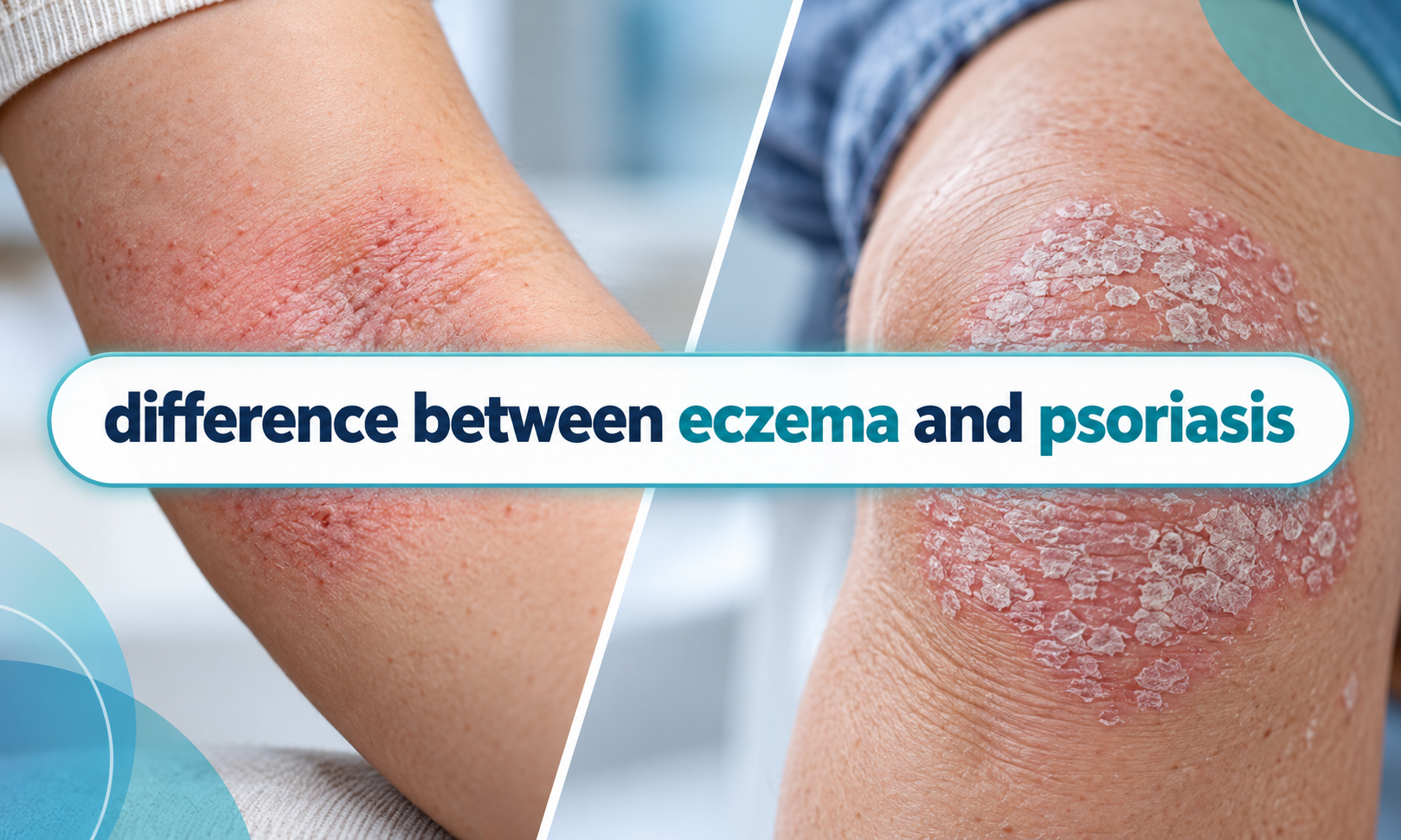
The difference between eczema and psoriasis is easiest to understand by looking at the type of rash, how intensely it itches, where it appears, and what other symptoms occur. Both are chronic inflammatory skin conditions that can cause dry, scaly, discolored patches, but eczema usually produces a more intensely itchy, less sharply defined rash, while plaque psoriasis often causes thicker, more clearly bordered plaques with scale.
The WebMD comparison of psoriasis and eczema emphasizes that the two conditions can resemble each other. A dermatologist may need to examine the rash, review its location and history, and sometimes perform a skin biopsy when the diagnosis is uncertain.
Eczema vs. Psoriasis at a Glance
| Feature | Eczema | Psoriasis |
| Typical appearance | Dry, inflamed, poorly defined patches; may ooze or crust | Thick, raised, sharply defined plaques with scale |
| Itch | Often intense and can dominate symptoms | Can itch, burn, or hurt, but itch is often less intense |
| Common locations | Skin folds, hands, face, neck | Outer elbows/knees, scalp, lower back, nails |
| Skin surface | Dry, bumpy, cracked; sometimes weepy | Thicker, rough plaques; often silvery or light scale |
| Immune pattern | Skin-barrier and immune dysregulation | Immune-mediated rapid skin-cell turnover |
| Other clues | Allergies/asthma may coexist | Nail changes and psoriatic arthritis may coexist |
What Does Eczema Usually Look and Feel Like?
Atopic dermatitis, the most common form of eczema, is often described as an ‘itch that rashes.’ The American Academy of Dermatology’s eczema symptom guide lists intense itching, dry scaly areas, scratch marks, raw skin, bumps, and sometimes leaking fluid or crusting.
On lighter skin, eczema may look red or pink. On darker skin tones it may appear brown, purple, gray, or darker than surrounding skin. Repeated scratching can also thicken the skin over time.
Where Does Eczema Commonly Appear?
Eczema can occur anywhere, but it commonly affects the crooks of the elbows, behind the knees, hands, face, neck, and other flexural areas. The pattern changes with age, so infants and adults may develop rashes in different places.
A damaged skin barrier also makes eczema-prone skin more vulnerable to irritation and infection. Oozing, yellow crusting, rapidly increasing pain, or fever may indicate infection and should be assessed.
What Does Psoriasis Usually Look and Feel Like?
Plaque psoriasis, the most common form, typically causes thick, raised areas called plaques. The AAD psoriasis signs and symptoms guide describes dry, thick, raised patches that may be covered by silvery-white scale.
Psoriasis can itch, burn, sting, or crack and bleed. Its borders are often more clearly defined than eczema. On darker skin tones, plaques may look violet, dark brown, or gray rather than bright red.
Where Does Psoriasis Commonly Appear?
Plaque psoriasis often affects the outside of the elbows and knees, scalp, lower back, palms, soles, and genital area. It can also affect the fingernails and toenails.
Nail pitting, thickening, discoloration, or separation of the nail from the nail bed can support a psoriasis diagnosis. Joint pain, stiffness, or swelling can suggest psoriatic arthritis and should be discussed with a clinician.
Is Eczema Usually Itchier Than Psoriasis?
Often, yes. Both conditions can itch, but intense itching is a hallmark of eczema. Scratching can create an itch-scratch cycle in which damaged skin becomes even more inflamed and itchy.
A recent Cleveland Clinic comparison notes that eczema generally causes more intense itching, while psoriasis often produces thicker plaques and can also cause burning or pain.
What Causes Eczema Compared With Psoriasis?
Both involve the immune system, but the biology is different. Atopic dermatitis involves immune dysregulation plus weakness in the skin barrier, which allows moisture to escape and makes skin more reactive to irritants and allergens.
Psoriasis is an immune-mediated disease in which inflammatory signals accelerate skin-cell production. Cells accumulate at the surface before they can shed normally, creating thick plaques and scale.
What Triggers Eczema Flares?
Common eczema triggers include dry air, heat and sweat, fragrance, harsh soaps, some fabrics, allergens, skin infections, and stress. Triggers differ from person to person, so identifying a pattern can be useful.
What Triggers Psoriasis Flares?
Psoriasis can flare after infections, skin injuries, stress, smoking, alcohol exposure, or certain medicines. Cold or dry weather can also worsen symptoms for some people. A trigger may provoke a flare without being the underlying cause of the disease.
Can You Have Both Eczema and Psoriasis?
Yes. The conditions are separate, but they can overlap, and a person can have both. The AAD notes that some children with an unclear rash may receive a diagnosis such as psoriasiform dermatitis when the features do not fit neatly into one category.
Seborrheic dermatitis can also overlap with scalp psoriasis in a pattern often called sebopsoriasis, which can make self-diagnosis from photographs even harder.
How Are Eczema and Psoriasis Diagnosed?
Diagnosis usually starts with an examination of the rash, its location, degree of itch, family history, and associated symptoms. Dermatologists can often tell the difference from the clinical pattern.
When the appearance is unusual or treatment is not working as expected, a small skin biopsy may help. Other tests may be used to rule out fungal infection, contact allergy, or another condition that resembles eczema or psoriasis.
Do Eczema and Psoriasis Use the Same Treatments?
Some treatments overlap, but the conditions are not treated identically. Moisturizers and topical corticosteroids may be used for either condition in appropriate situations, while other medicines target different immune pathways.
Eczema treatment may include barrier repair, trigger avoidance, topical calcineurin inhibitors, topical JAK inhibitors, phototherapy, or systemic medicines and biologics for more severe disease. Psoriasis treatment can include vitamin D analogues, topical steroids, phototherapy, systemic medicines, and psoriasis-specific biologics.
Why Does the Correct Diagnosis Matter?
A medicine that works well for one disease may not work for the other. Cleveland Clinic specifically notes that biologic medicines are targeted and are not automatically interchangeable between eczema and psoriasis.
Repeatedly treating an uncertain rash without a diagnosis can also delay recognition of infection, fungal disease, contact dermatitis, or another condition.
When Should You See a Dermatologist?
- A rash lasts for weeks or keeps returning despite basic skin care.
- Itching regularly disrupts sleep or daily activities.
- The skin becomes painful, warm, swollen, draining, or covered with yellow crust.
- You develop nail changes or joint pain along with a scaly rash.
- A rash is widespread, rapidly worsening, or difficult to identify.
- Over-the-counter treatment repeatedly fails or makes the rash worse.
Frequently Asked Questions About Eczema and Psoriasis
Are Eczema and Psoriasis Contagious?
No. Neither eczema nor psoriasis is contagious. You cannot catch either condition by touching, sharing towels, or being close to someone who has it.
Can Eczema Turn Into Psoriasis?
Eczema does not simply transform into psoriasis. They are different diseases, although a person can develop both or have a rash that initially resembles one and is later diagnosed as the other.
Which Is More Serious, Eczema or Psoriasis?
Severity depends on the individual. Either condition can be mild or severe. Psoriasis can involve joints and is associated with other inflammatory health risks, while severe eczema can cause major sleep loss, skin infections, and substantial quality-of-life effects.
Can Photos Tell the Difference?
Photos can provide clues but cannot reliably confirm a diagnosis. Lighting, skin tone, scratching, infection, and treatment can change how a rash looks. Persistent or uncertain rashes are best examined directly.
What Is the Bottom Line?
The main difference between eczema and psoriasis is the pattern of inflammation. Eczema usually causes intense itch with dry, less-defined or sometimes oozing patches, often in skin folds. Psoriasis more often produces thicker, sharply defined plaques with scale on areas such as the elbows, knees, scalp, and lower back.
There is substantial overlap, and both conditions can look different across skin tones and body locations. If the rash is persistent, painful, infected, associated with nail or joint changes, or not responding to treatment, a dermatologist can confirm the diagnosis and match treatment to the correct condition.